

Notes from the Field
Canadian Peace and War Field Study

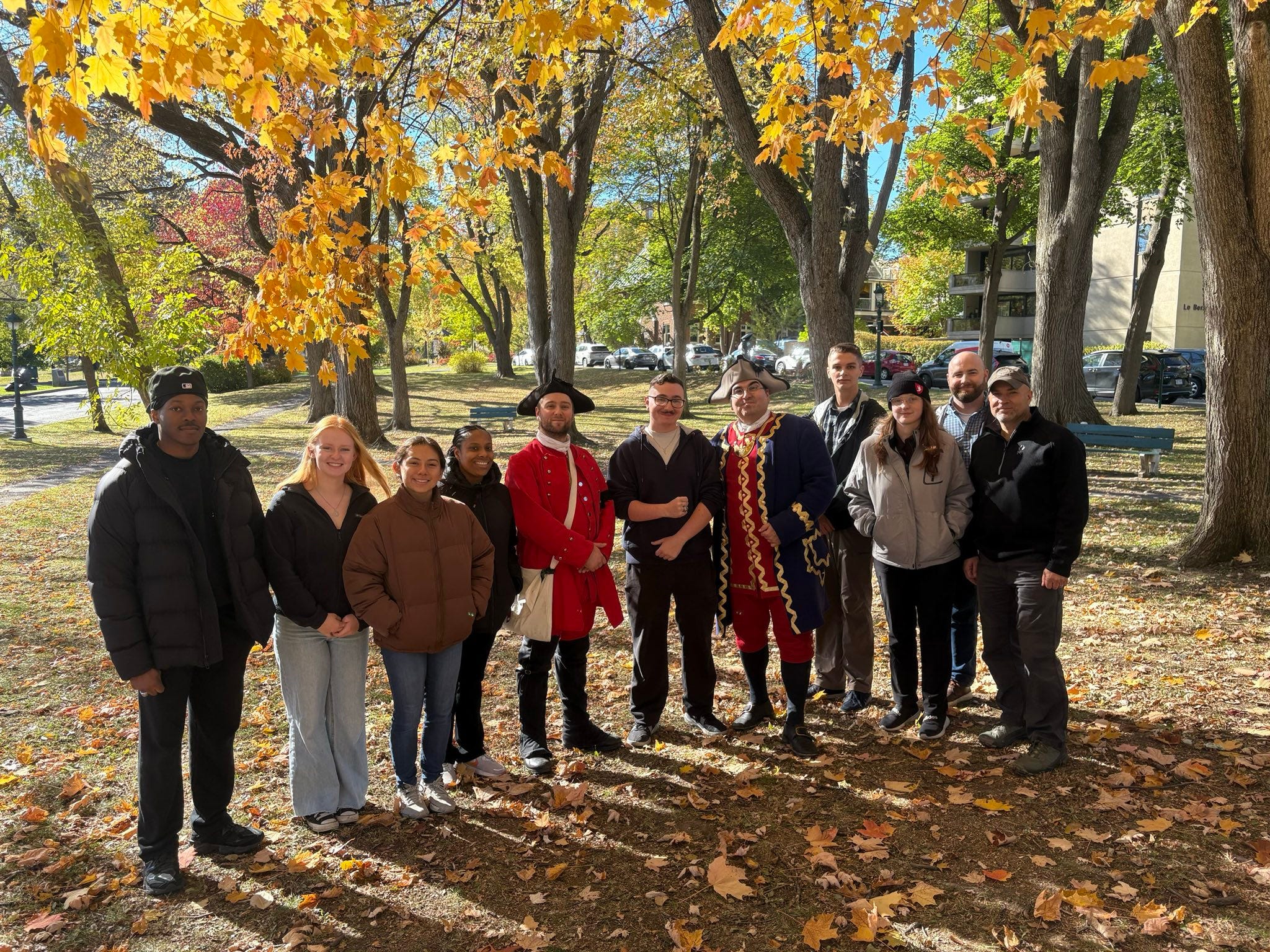
The Canadian Peace and War Field Study brought together cadets, officers, and scholars from Canada, the United States, and the United Kingdom for a two-day academic and cultural engagement focused on pivotal historical conflicts and their enduring relevance. Hosted jointly by Canadian institutions and international partners, this program was designed to foster cross-national dialogue on leadership, strategy, and the human dimensions of war and peace.
The field study aimed to enrich cadets’ education by providing first-hand exposure to historic battlefields, fostering international exchange among Canadian, U.S., and U.K. delegations, and deepening cultural understanding, particularly regarding Indigenous contributions and perspectives. The intended outcome was to connect lessons from the past to contemporary security challenges while building relationships among future allied leaders. Follow-up actions included debriefing sessions at Norwich, student presentations on key takeaways, and the preparation of a joint report or reflection paper to capture outcomes and inform future exchanges.
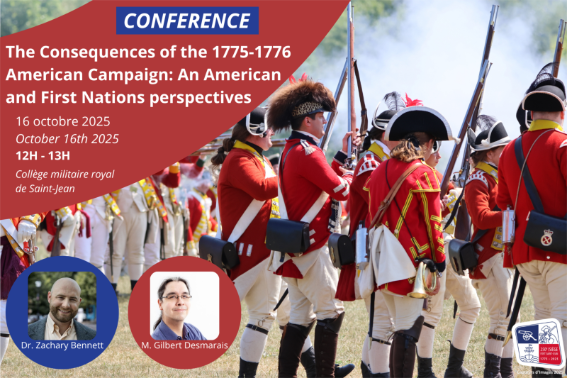
Dr. Zachary Bennett Presentations
RMC St. Jean: “1775: Year of Possibilities”
I emphasized how we take for granted how revolutionary the American Revolution was: the 1775 invasion shows that American Patriots were advocating a universalism not seen before in history. The American invasion assumed French Canadians would respond positively to Patriot promises of liberty and self-government. This was a radical departure from the past since the American colonists and French Canadians had been bitter enemies for the prior 90 years and fought wars in no small part motivated by intense anti-Catholic prejudice. That Patriots offered Canadians the opportunity to join their revolution as brothers in arms shows how seriously they took the ideas of liberty and human equality. I also emphasized that Patriots came quite close to conquering Canada, in no small part because many French Canadians joined them, or expelled British officials on their own. Overall, I emphasized that we shouldn’t look backward at history, since outcomes are never inevitable. I invited people to think about how different the history of North America would be if the current US-Canadian national boundaries never existed. Such a proposition might be fanciful to us today, but it was a real possibility in the revolutionary year of 1775.
Quebec City: “Nova Francia Delenda Est: Quebec City in the American Imagination”
When one looks at the American invasion of Canada in 1775, it’s hard to make sense of why it happened in the first place since the logistical challenges were so great and the potential military benefits dubious at best. I argued that we need to understand the mental worlds of eighteenth-century Americans in order to make sense of the invasion. For the prior 90 years, colonial Americans were gripped in an existential struggle with French Canada. Although scholars today explain these conflicts as fought over resources and power, people living through them at the time saw these wars primarily as religious crusades against Catholic or Protestant heretics. In the American mind, Quebec City was the “American Babylon” from which all the evil that plagued them emanated. The memory of these British invasions of Canada were forefront in the minds of American Patriots who fought in the Seven Years War (including the planners/leaders of the invasion: Washington, Montgomery, Arnold), and they made the assumption that conquering Canada would be key to their military struggle as it had been in the past. So, understanding the 1775 invasion of Canada requires adjusting our chronological framework by seeing it as the end of a long series of conflicts, rather than the start of a new war (which is how most people see it).
Giancie Cope
The Canadian Field Study was primarily focused on the 1775 invasion of Canada by the United States. Prior to this trip, I knew very little about Canada or its military culture. Through conversations with Canadian officer cadets at Saint-Jean, I gained valuable insight into what it is like for them as they begin their military careers. Unlike in the United States, students from the Quebec region graduate high school in the 11th grade and then attend an intermediary year of college before entering military school. By the time they begin their college-level military education, they already know which branch of the armed forces they will be joining and what specific job they will hold. I found this to be an immense decision for someone at that age, yet the cadets expressed great pride in serving their country.
I also learned about the differences in size and structure between the Canadian Armed Forces and the U.S. military. The Canadian military has less than one-third of the members that the United States does, and this shapes how they use and train their personnel. For example, individuals from rural areas are often trained to protect and serve in the same cold regions they grew up in, where temperatures are frequently below freezing. This connection between geography, culture, and service showed me how the Canadian military adapts to its environment and utilizes its people’s strengths.
This experience helped me become a better leader because it exposed me to a new culture and perspective on service. I realized that leadership requires not only knowledge and decision-making but also cultural awareness and respect. In Canada, simple gestures such as greeting others in their native language whether English or French are seen as a sign of respect. Before this trip, I hadn’t fully appreciated how meaningful those small acts of cultural understanding could be. I also noticed that Canadians often identify with their language groups, referring to French speakers as Francophones and English speakers as Anglophones. While this division can create cultural boundaries, it also highlights the complexity and diversity within Canadian Wendy Cantor Hernandez
Visiting Canada gave me the chance to explore key moments in its military history, especially the Battle of Montreal and the Battle of Quebec. Seeing the actual sites helped me better understand how these events shaped the region. What stood out even more were the conversations I had with members of the Canadian military and the Royal British forces. Hearing their perspectives added a personal layer to the historical context and made the experience more meaningful.
Prior to visiting Canada, I had only learned of American history strictly through the lens of an American. Getting to learn about American history through a Canadian lens expanded my perspective. It is amazing to see how much smaller battles helped shape not only Canada but also the United States. From a presentation given by a representative of the Mohawk Nation, I learned a lot more about Native American history in the region of Canada and how the tension between them and the Americans rose. The United States’ desire to continue its expansion and influence caused tension between Native American tribes. From this tension, there was disapproval of how the United States grew. Instead of helping the tribes stick together, the United States encouraged the people of the tribes to choose sides. During this time, the United States was more worried about expanding physically I order to gain more power. This helped in the short run, but it hurt more in the long run, especially when Canada became a British Territory after the Battle of the Plains of Abraham. One of the biggest causes of the War of 1812 was the tension between the Native Americans and the United States. Arguably, Native American history is disregarded in many ways, despite having deeply affected the beginning of the development of the United States, which is crucial to understanding who the United States is now.
It was interesting hearing how the United States is perceived historically in other regions, but also how the United States is perceived politically. In our education system, it is often that the battles that have been won in American History are taught more than the losses. Due to this manner of teaching, it often inflates the ego of an American. I am proudly American; however, Canadians rightfully know when to humble a fellow American, especially when regarding one’s history. Due to the pride of Americans, politics in the United States is often influenced by this. The American politicians have been known to be radical within the states, but even more outside. I held many conversations with both the British and Canadians about how the United States has been running its politics compared to their own countries. The most common topic was about President Trump and his unapologetic use of his freedom of speech. With him as the president, people who are not American automatically assumed that I held similar ideologies to his or that my ideologies were completely the opposite of his. Americans are viewed as radical thinkers due to how often the media portrays our political system.
I’m genuinely thankful for the opportunity to take part in this trip. Meeting members of both the Canadian and British military added a personal dimension that deepened my understanding of the history and politics. I appreciate the chance to engage with people who carry forward traditions and stories. It made the trip not just educational, but memorable in ways I didn’t expect.
Joshua Hamilton
Participating in the Canadian Field Study was a deeply impactful and transformative experience, one that broadened my perspective on leadership, history, and international cooperation.
Standing on the historic grounds where the 1775 American invasion into Canada and the 1763 British conquest unfolded allowed me to reflect on the immense challenges and sacrifices made during those early military campaigns. Seeing the walls of Québec City firsthand and overlooking the river where British artillery once launched devastating fire into the city gave me a powerful image of how warfare, even centuries ago, brought destruction with a level of lethality that is often underestimated in modern reflection. These historical sites reminded me that leadership in conflict is not theoretical, it has real consequences on lives, cultures, and societies.
Throughout the field study, I had the privilege of engaging with British and Canadian military personnel as part of the United States delegation. These interactions expanded my worldview and helped me better understand how our allied nations approach defense, security, and leadership development. Hearing their perspectives underscored the importance of cross-cultural communication and diplomacy in strengthening international partnerships.
One of the most eye-opening elements of this experience was learning about the differences in how Canadian officers are developed. Unlike in the United States, Canadian students complete high school in the 11th grade and then enter a preparatory year of college before attending military school. Additionally, Canadian officer candidates are trained to operate fluently in both English and French, reflecting the bilingual nature of their nation and the cultural inclusivity required of their armed forces. This highlighted the value of adaptability and linguistic proficiency in modern leadership, skills that ensure future officers can communicate effectively across diverse environments.
Overall, this field study not only enhanced my understanding of military history but also contributed significantly to my personal growth as a developing leader. It reinforced the importance of studying the past to better prepare for the future and emphasized the need for cultural awareness in global military cooperation. I left Canada with a renewed appreciation for our allies, a deeper respect for the complexities of leadership, and a stronger commitment to improving myself so I can better serve those I will one day lead.
Timothy D’Orsi
I would definitely have to say that our trip to Canada with the University was extremely eye-opening. Not only did I get to see a brighter side of a culture I knew almost nothing about, I got to see the functions of a military force that my nation has been partnered with for decades. prior to our trip I had been to RMC St John once before however attending this time was much different. I had much more time in the barracks with the Canadian Cadets and was able to speak to them more about the traditions and applications that the Canadian military use on a day-to-day basis. I was lucky enough to be quartered with a Canadian Cadet as well as a Belgian officer Cadet and he allowed me to have some more insight about our European allies dealing with North American forces. While my position in the trip was not in a leadership role being one of the few senior Norwich Cadets in attendance it allowed me to still take a senior position among the group. Being senior in a group of cadets is one thing on campus and in the corps of cadets being a part of a delegation in a foreign country with those same Cadets allowed a different type of leadership to be present. There was some crisis management whether it was meeting time hacks or making sure we were all dressed appropriately for the event we were about to attend, I was able to use my experience as a Norwich Cadet to assist the younger Cadets that were on our trip. While I have been to Canada prior to our Excursion I knew very little about Quebec culture and greater Canadian culture. I had no idea that Quebec had almost seceded from Canada in the 1990s. I had no idea that the Canadian Army currently uses its native population as military assets to patrol their Northern provinces. I had no idea that the Canadian Air Force only operates 320 aircraft. All of these things helped me better understand one of our country’s greatest and longest allies. It is more heartening to see this since the very reason we were attending this conference was due to an armed conflict between our two Nations 250 years ago. Quebec culture is still very much alive especially inside Quebec City as well as the seeming tensions that exist between Quebecois people and the rest of Canada. more so a seeming clash and culture between the Franco and Anglo Cadets ways of life. While they all accept that they are Canadian in some aspects the Quebecois are definitely more independent. As a history major I was in my happy place getting to see so many important historical sites well. I do not know that my non-history-oriented Norwich counterparts enjoyed it as much as I did; they all attested to the importance of needing to understand history so close to us. I was able to get the contact information of several Cadets both from RMC Kingston and RMC St John and I believe it is more than beneficial to have future officers from both of our Nations be in contact with each other and know how to work with each other in some capacity. Having three nations that were all formally in conflict with one another in the past together in one room breaking bread and having wine together is a very rare thing in today’s world. The fact that we did this and that so few Americans will get to experience what I’ve experienced makes me almost sad. I wish every American was able to have the experience I just had over the past week Unfortunately they cannot so I will have to continue to speak the good graces of our very gracious host.
Studying the 1775 invasion from the Canadian perspective further expanded my worldview. I learned that while the United States saw the invasion as a strategic move to prevent a British attack, for Canadians, it represented an invasion of their homeland. Understanding this difference taught me that leadership, especially in an international context, requires humility and the willingness to see history through others’ eyes. Canadians today still take great pride in their country and in their resilience during times of conflict and witnessing that pride firsthand gave me a deeper appreciation for their national identity.
Overall, this trip not only expanded my understanding of Canadian history and culture but also strengthened my leadership skills and cross-cultural awareness. It reminded me that effective leadership involves empathy, respect for different perspectives, and the ability to connect with people across cultures.
Kristin Sanderson
The 4 days spent in Quebec along with the Norwich delegation was an excellent experience. I was able to practice my French language skills, meet people from other militaries, and learn about the Quebecois culture and history a bit more. I was very kindly welcomed at St Jean and got an interesting perspective on how Canada trains their future officers along with some of their lingo. This is helpful for me as I may one day have to work with Canadians, especially in the Coast Guard, and I can more easily adapt to what they are familiar with along with their customs. As the trip leader, this excursion was very good leadership experience and was a slight challenge as well. I learned that to get a team to do something they will want to know the why and the specific details. It seemed that without very clear instructions, a group’s interpretation can be wildly different as people see those instructions in different ways. One struggle was keeping the team on the deadlines which I set for them and that sometimes it takes a little push to keep to schedule. I also realized there are varying degrees to which people are experienced in acting and adapting while abroad, and helping others better prepare themselves to adapt to a new environment was an enjoyable challenge that I faced. I am glad that all three nations who were there were able to attend the conference, as I believe that Canada, the UK, and US, are a crucial part of our success as a nation, as well as our alliance with them being something that we absolutely cannot lose.
Megan Sweeney
While in Quebec I learned more about history than I have been interested in learning in a long time. I really enjoyed all of the tours we got and being able to sit in conferences to hear multiple sides to the same story. It’s easy for us as Americans to forget about and not talk about situations that did not end up in our favor. All of the history we learned there taught me a lot about the connection between us and the other countries. However, I feel as though I learned more important things on this trip.
While I learned a lot about the history, and it is super important to learn about, what I found more interesting was talking to the British officers and the Canadian cadets about their different military lifestyles. During the first night’s dinner, I talked to one of the British officers for the whole time about his life and mine and how it differed and how it was similar. There was no politically motivated debates, only two people talking about their experiences. I really appreciated hearing about how other military officer trainings are different. Throughout the weekend I also talked to many Canadian cadets about their experiences. We especially focused on the first year training. It was really interesting to hear how they go to something like basic then have a bit more freedom at school. And then for the Kingston cadets, they don’t really have daily training at all. They have weekends where they train and specific times to train, but school is mostly just school.
While in many of the tours that we were on I felt a lot of animosity from the tour guides towards the Americans. It was refreshing to see our military counterparts not holding any bad blood and willing to move to the future rather than staying locked in the past.
Matthew Sedutto
Between October 15 and 18, seven Norwich Cadets and I, along with Professors Morris and Bennett, conducted a field study to commemorate and learn from the 1775 American invasion of Canada during the Revolutionary War. During this trip, we traveled from Montreal, where we lived with Canadian Cadets from the Royal Military College of St. Jean and the Naval Reserve in Quebec City. We met with members of the Canadian armed forces, government, military academic institutions, and British officers, ensuring that every nation and perspective was represented, just as had been present during the invasion 250 years ago.
I gained a greater appreciation for the value of studying abroad with foreign exchange students engaged in similar research. While learning about the history, we not only learned about the events on the ground and where they occurred, but also the perspective of different Nations and their stake in remembering 1775.
The history itself was enlightening, and Dr. Bennett highlighted the American experience during a speech. While many aspects contributed to the American failure, the lack of grasping historical context was a critical pillar in the American decision to invade Canada, and the failures of the campaign. Throughout the trip, especially once in Quebec City, the 1759 invasion was often emphasized—sometimes more than the 1775 invasion—since one cannot discuss the motives, strategy, and downfall of 1775 without explaining the Americans’ reasoning, grounded in the 1759 success.
The British and Canadians were proud to teach us Americans a great deal about the French and Indian War. In 1759, they highlighted that British General Wolfe led a daring invasion of Quebec City, a vital chokepoint on the St. Lawrence River. Quebec, meaning “Where the river narrows”. Quebec controlled access to the continent’s interior. General Wolfe successfully invaded the city after several other failed invasions in the late 17th and early 18th centuries. His large, well-equipped force drew the French onto open ground, where they were defeated, and the city was captured.
Learning about the history during this trip was further enhanced by learning alongside British and Canadian counterparts, both Francophone and Anglophone Canadians. British officers had a unique perspective on the entirety of the “War of Independence,” as they termed it. They often remained respectfully listening to the tours and history, and focused more on their 1759 invasion of Quebec. Canadians, on the other hand, honestly and proudly boasted at times that they defeated the Americans and highlighted our failed invasion.
As our field study traversed the heights, cliffs, streets, and rivers of Quebec, we felt the peril that those Americans faced 250 years ago. Montgomery’s experience in 1759 may have blinded him to the city’s difficulty, recalling a quick victory that proved misleading. The Americans’ spirit was remarkable, but as we saw firsthand, war is ultimately won through resources, planning, and wisdom—not willpower alone.
Justin Agri
I reflect on a quote from Benjamin Franklin, “Tell me and I forget, Teach me and I remember, Involve me and I learn.” In ways that no classroom could match, taking part in the field study at the Royal Military College Saint-Jean and Québec City was an academic and cultural experience that will never be forgotten. With the objective to examine how the legacy of 18th-century conflict continues to influence our modern notions of peace and war, our delegation had the unique opportunity to interact directly with Canadian and British officer cadets, historians, and defense experts over the span of four days.
Our Canadian counterparts greeted us with tremendous hospitality at RMC Saint-Jean, where our journey began. Our understanding of the extensive history of Canada’s military legacy was strengthened by our visit to the Fort Saint-Jean Museum and our participation in the morning flag-raising ceremony. We were prompted to consider colonial struggle and the often-disregarded contribution of Indigenous peoples to the history of North American armed conflict by Dr. Zachary Bennett’s talk and the viewpoint expressed by a Mohawk Nation delegate.
Our time in Montréal provided a unique opportunity to connect the past with the present. Visiting the Château Ramezay Museum, which was once the American High Command during the 1775 campaign, helped us understand the international conflicts during that period. The evening reception at the Côte-des-Neiges Armory allowed us to engage in meaningful discussions with officers from the 2nd Field Artillery Regiment, offering a firsthand look at how our allied militaries promote cooperation and shared values.
The trip’s most memorable moment occurred the following day in Québec City. There was a real sense of connection to the events we were investigating when we toured the Plains of Abraham and walked the same routes that soldiers took during the Battles of 1759 and 1775. With remarks from LTG (Ret.) Jocelyn Paul, the formal dinner and conversation at the Québec Garrison Club focused on themes of heritage, reconciliation, and the development of leadership within the modern armed forces.
Beyond the academic and professional value, this trip fostered lasting friendships and a deeper appreciation for the importance of international collaboration in peace and security. It reminded us that understanding conflict also means understanding memory, how nations choose to commemorate, learn from, and move beyond their histories (whether positive or negative). As a cadet at Norwich University, this experience strengthened our commitment to the university’s values of service, leadership, and global engagement.


